
How Our AI Bookkeeper Caught a $9,270 Mistake
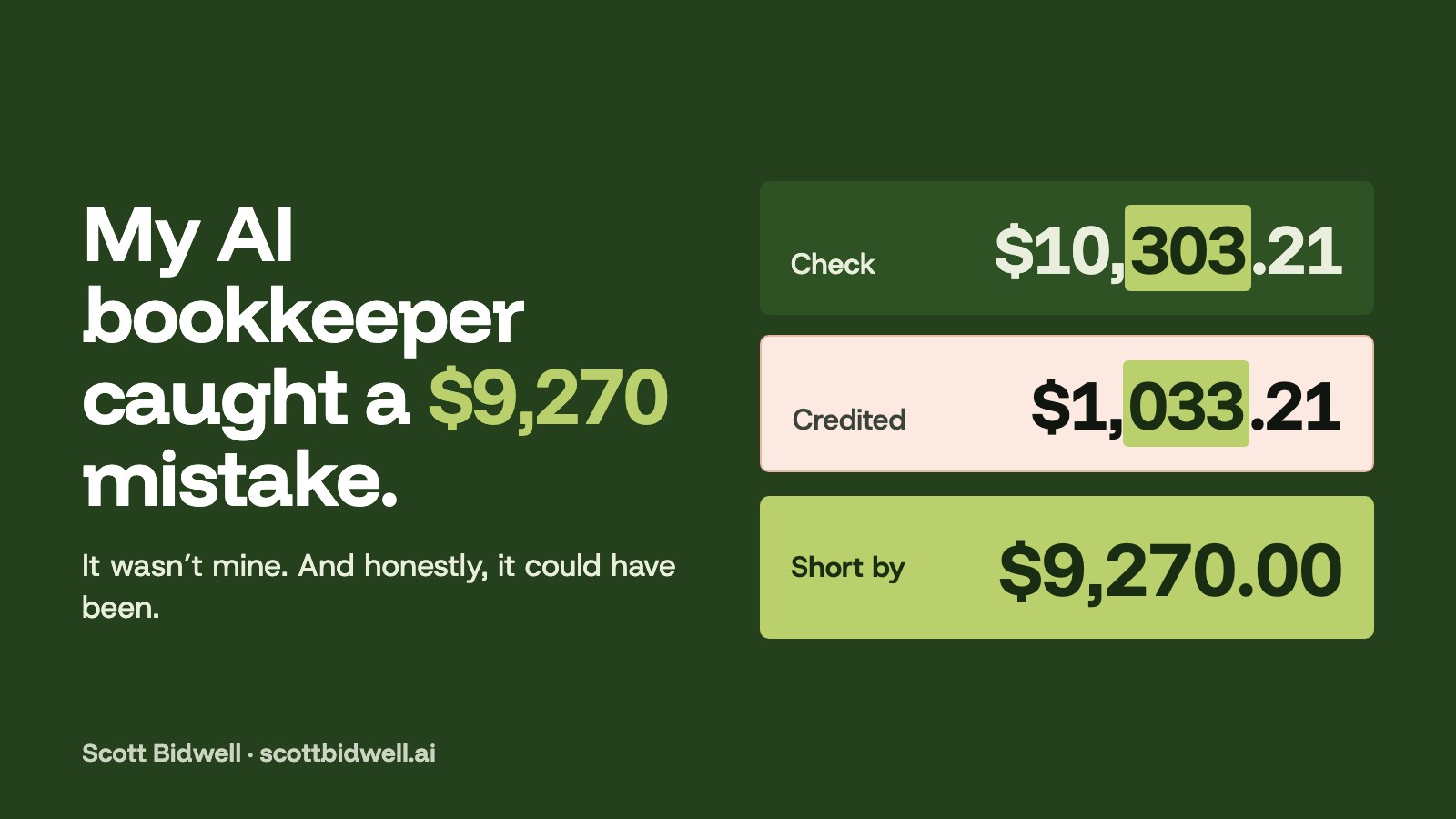
My AI bookkeeper caught a $9,270 mistake.
It wasn't mine. And honestly, it could have been.
I'll get to that. But first, I want to tell you why I built it, because the reason matters more than the tool.
I Wasn't Looking for AI
I don't enjoy bookkeeping.
Matching every deposit to the invoice it paid. Coding every charge to the right category. Reconciling the accounts so the numbers actually line up.
It's important work. It's just not work I'm good at when I'm doing it at the end of a long day.
So I put it off. And when I finally sat down to catch up, I was tired and distracted. I'd code something to the wrong category. I'd miss a deposit. Then I'd have to go back and find my own mistakes.
I wasn't out shopping for an AI tool. I was looking for a way to stop doing a job I don't like, and to stop doing it badly.
What Our AI Bookkeeper Actually Does
Every 48 hours, it works through our bank feed in QuickBooks. Here's what it handles:
- It matches client deposits to the invoices they paid.
- It codes payments that follow a clear pattern, like the same software every month.
- It follows the standing rules I've given it for the kinds of charges we see all the time.
- It leaves everything else alone and gives me a short list of what it couldn't place.
That last part is the most important.
The Rule: Don't Guess
When I set it up, I gave it one rule.
"I don't want you to guess at all."
If it isn't certain, it doesn't post it.
A wrong entry in your books is worse than an empty one. An empty one is obvious. A wrong one hides until tax time, or until it costs you something.
So the bookkeeper only posts what it can prove. Everything else comes back to me, with a note about why it stopped.
That rule is why I trust it. It's also why I now spend a few minutes on the few items left over instead of an evening on all of them.
Not sure which job in your business to hand off first? Let's look at it together.
Meet with ScottThen It Caught the $9,270
Here's the part I still think about.
A client paid us with a check for $10,303.21.
When the check was deposited, it got keyed in as $1,033.21.
A few digits got mixed up. $9,270 short.
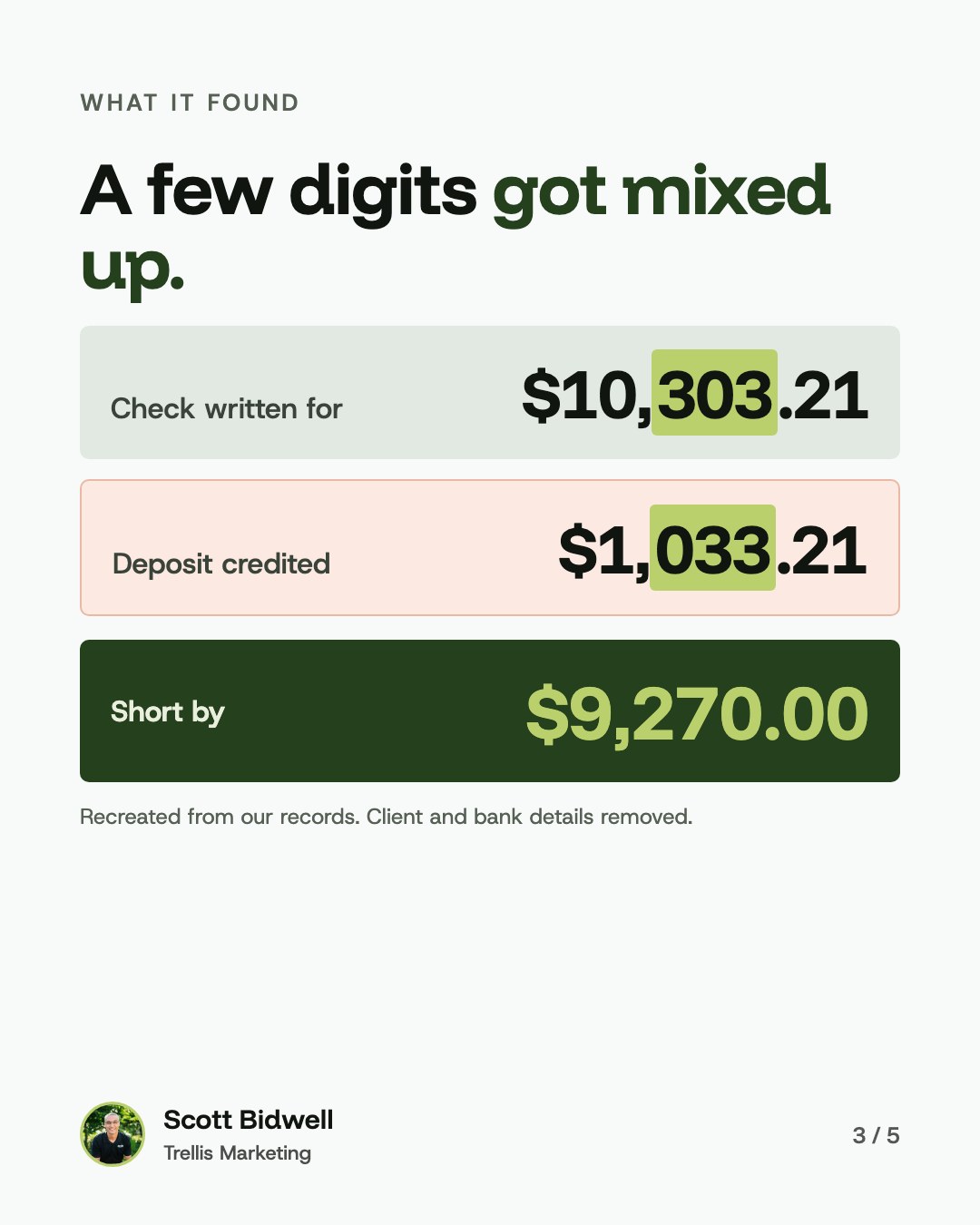
The next day, the AI bookkeeper tried to match that deposit to the client's account. The numbers didn't line up, so it didn't guess. It even went and looked at the picture of the check in our online banking portal to confirm the amount was wrong. Then it told me exactly what to ask the bank to fix.
The bank fixed it.
I want to be clear: I'm not upset with anyone. Tellers handle stacks of checks every day. A few digits getting mixed up is just part of it. I've made plenty of my own mistakes in these same books.
Would I have caught it? Eventually. But probably weeks later, because I'm slow to get back to the accounting. A bookkeeper that checks every 48 hours caught it the next day.
That one catch paid for my AI subscription for the whole year.
Start With the Job You Keep Putting Off
People ask me where they should start with AI. My hunch is it usually isn't with AI at all.
Start with the job you keep putting off. The one you don't enjoy. The one where you make mistakes because your head is somewhere else.
- Write down the job in plain steps, the way you'd explain it to a new hire.
- Decide the rules. What's always true? What should never be guessed?
- Let it do the repeat work, and have it hand back anything it isn't sure of.
- Check what it did for the first few weeks before you trust it on its own.
That's how we're trying to work at Trellis: automate as much as possible, and make everything else personal. Bookkeeping doesn't need my personal touch. Our clients do.
What's Next
Once the books were in good shape, we turned to the next job I was slow at and kept making mistakes on: our invoices. That's part two.